Wednesday, January 1, 2014


Progress Report: Siberia


This past summer, French Ph.D. student Felix Brédoire from INRA Bordeaux worked on establishing a cryogenic extraction system at the ZALF isotope facilities. He had a short visit with Paul Koeniger to learn about his method using glass vials to expedite this normally laborious and time consuming first step to analysis.The method can be tricky and is specific for each sample type (soil vs. leaves vs. wood cores).


Because we are interested in the plant water access at our Siberian sites, we began with soil and found that after about an hour we could retrieve more than 97% of the water present in the sample using this method.


With further modification to avoid condensation in the transfer, we are achieving much better results. Next is to extract the water from samples collected from last year's sampling campaigns. The isotopic  values of the extracted eater will establish a baseline to this current year's snow manipulation.


The question of different water pools available for plants is fundamental to understanding how forests, grasslands, and croplands might adapt to or be managed for climate change. So, we hope to learn which water pools are important to plants over the Siberian growing season. The dynamics of the refilling of soil water has become really interesting lately since Renée Brooks and colleagues discovered that plants play a bigger role than previously thought. Incidentally, the idea that soil water pools are very heterogeneous may complicate our use of isotopic mixing models to identify plant source water!

In this area of Siberia, snow levels are expected to increase. The higher level of snow may lead to soil that does not freeze (or not as much) over the winter. If the soil does not freeze then we might see an increase in the biogeochemical cycles of nutrients, and the soil water pools below ground may shift as well. In our experiment this year (2014) we will double the snow level on different plots. We are hoping for a good snow year for the manipulation (but not too much)!


Sunday, November 3, 2013

Field Sampling

One of the best part of biogeochemical research is getting out into the field. First of all, seeing the research site set within the landscape gives context and relevance to the project and the expected outcomes. Second of all, excursions into the field expose the non-natives (us) to the communities that work close to the land and resources that we study. When we are really lucky, we can take part in the fruit of the land. We are lucky to have a local apple press near by our study pot-holes (small water bodies). The owner is quite eccentric, but his group makes juice and apple cider wine (even a sekt) from local orchards. 

Amazingly, the owner didn't reference certain orchards when we talked about which apples were used, but individual trees! The taste is unique, very earthy, and takes a sip or two to get used to, but I think it would be welcomed at any table up here in NE Germany during the dark winter, crisp spring air, or the still summer.
Apples ascending the press-belt

Tuesday, September 10, 2013

Ecological Society Meeting in Potsdam


This week the Ecological Society of Germany, Austria and Switzerland is holding a meeting in Potsdam. Kai Nitzsche, PhD candidate, is presenting his poster on kettle holes (pot holes if you are from North America) dispersed across the agricultural landscape of NE Germany. He will perform some very cool experiments regarding priming of organic matter in soil and sediments, and water flow into these small water bodies.  Here is his poster he will present, (click on it for the pdf):


Adam Roddy will also present a talk about his work in Southern Germany investigating isotopic non-steady-state of leaf water.
Canopy position influences the deviation of 
plant-transpired water vapor from isotopic steady-state

If you are lucky enough  to be there, then don't miss these presentation opportunities! 


Saturday, September 7, 2013

Isotope Seminar in Slovenia Forestry Institute 


I was recently in Ljubljana to help give a seminar on stable isotope applications in forest research. There is quite a lot of ground to cover for such a course, but one week was sufficient for the Slovenian post-docs and PhD students. 


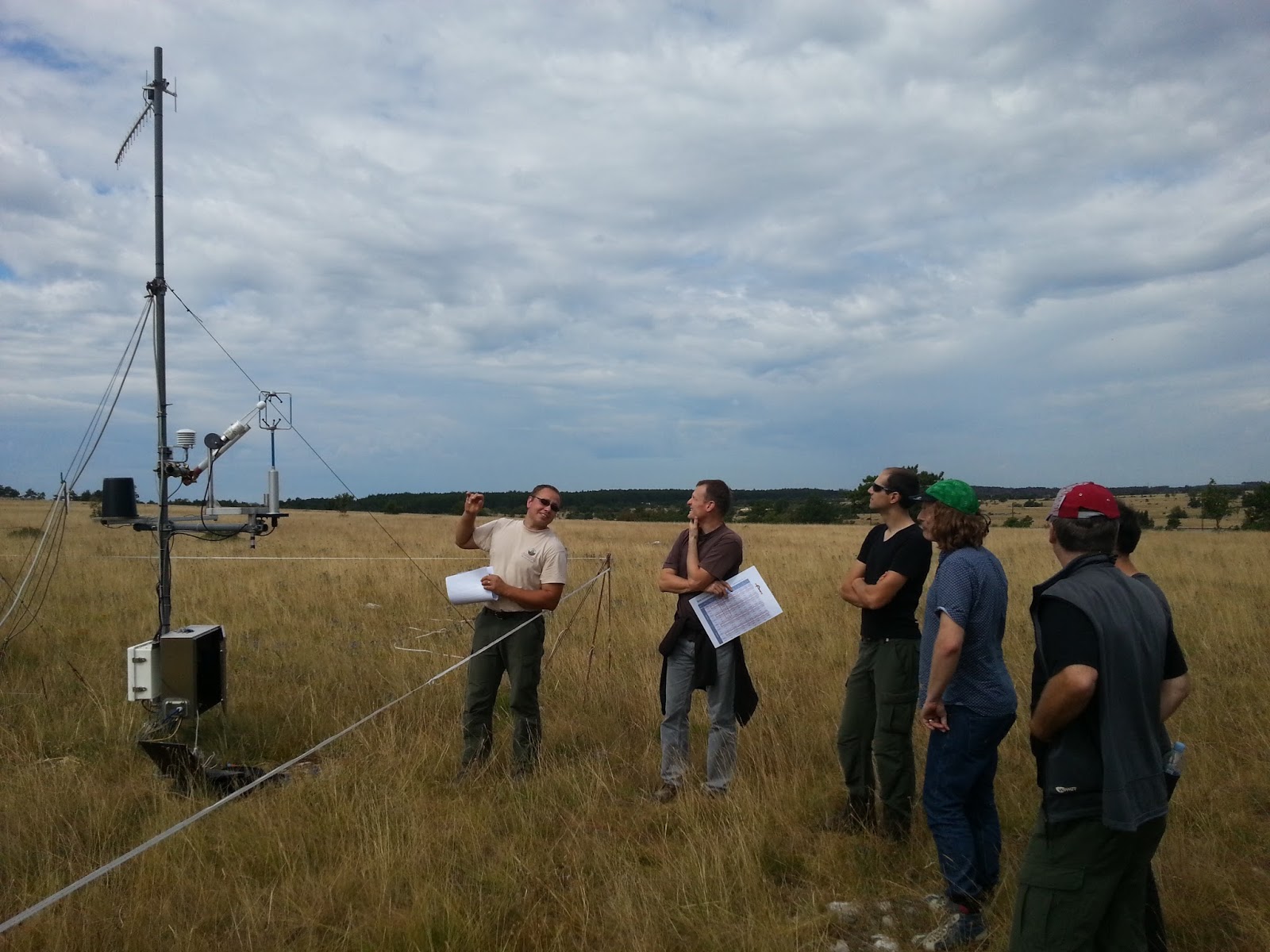
We also went to their field site where they maintain two eddy-covariance towers. They compare the two towers, one in the open grassland and the other in a sparse woody landscape, to get a handle on woody encroachment. This site is particularly special because not only is there the non-homogenous canopy to deal with (reminiscent of the California Foothills) .....


but also these sink holes


These are dotted across the landscape and can be easily seen from satellite imagery. The locals have actually surrounded the edges with limestone so they show up even clearer in the picture. In the past, Slovenians would plant gardens in the sinkholes because they are more fertile and have a deeper soil layer. Clearly these are hotspots of biogeochemistry and could play an important role in the landscape.


I had a good time overall and I was able to see a few uniquely Slovenian creations:


A Shepard's temporary home


And these hand sewn/crafted trees displayed in the SFI's main building. I can't imagine the amount of time and skill it took to craft the forest they house. 

Tuesday, September 3, 2013

Live, from the Ecotron! 


For the next couple of weeks I am in Montpellier, France working at the amazing CNRS Ecotron facility. The project stems from a collaboration of many european partners who are interested in circadian rhythms of ecosystem fluxes. Hopefully, our experiments will improve the basic understanding of how plant and soil CO2 and water fluxes are regulated, thus improving general ecosystem models. It is also fun to think about how ecosystems rely on internal time cycles to function- is there a competitive advantage? Can we see this expressed at the gene and RNA level? Do soil microbes synchronize their clocks to the dominant vegetation? Maybe these are the next questions to answer.

As you can see in the pictures below the Ecotron allows you to monitor entire intact monoliths removed from the field in isolated chambers-with replicates! Below, the monoliths are placed on lysimeters allowing for a pretty tight water balance, and of course, the data are collected continuously. It doesn't hurt that the facility is located within a beautiful landscape in a region where great food and wine are all around! 

My 4am to 5pm shifts at the LiCor have just ended so I look forward to a bit of rest, then I will take a look at some of the data, of which there are plenty, in the coming days.    


Tuesday, August 27, 2013

New paper in review at Biogeosciences Discussion!

This paper is part of Katrin Attermeyer's PhD work at IGB. She added carbon from extracted algae to carbon from labeled beech leaves. Turns out the microbes loved it!


Friday, August 2, 2013

New Proposal Submitted!!

After considerable blood, sweat and tears had been spilled, I submitted a new proposal to the DFG Biodiversity Exploratories! My Co-PI's and I will investigate the relationship between soil respiration and biodiversity. When it is successful I will give more details, but in the meantime these word clouds give some indication... ..